Investment Property Financing
DSCR Loans: Why Good Deals Still Get Denied in 2026
 Matt Robertshaw · NMLS #925153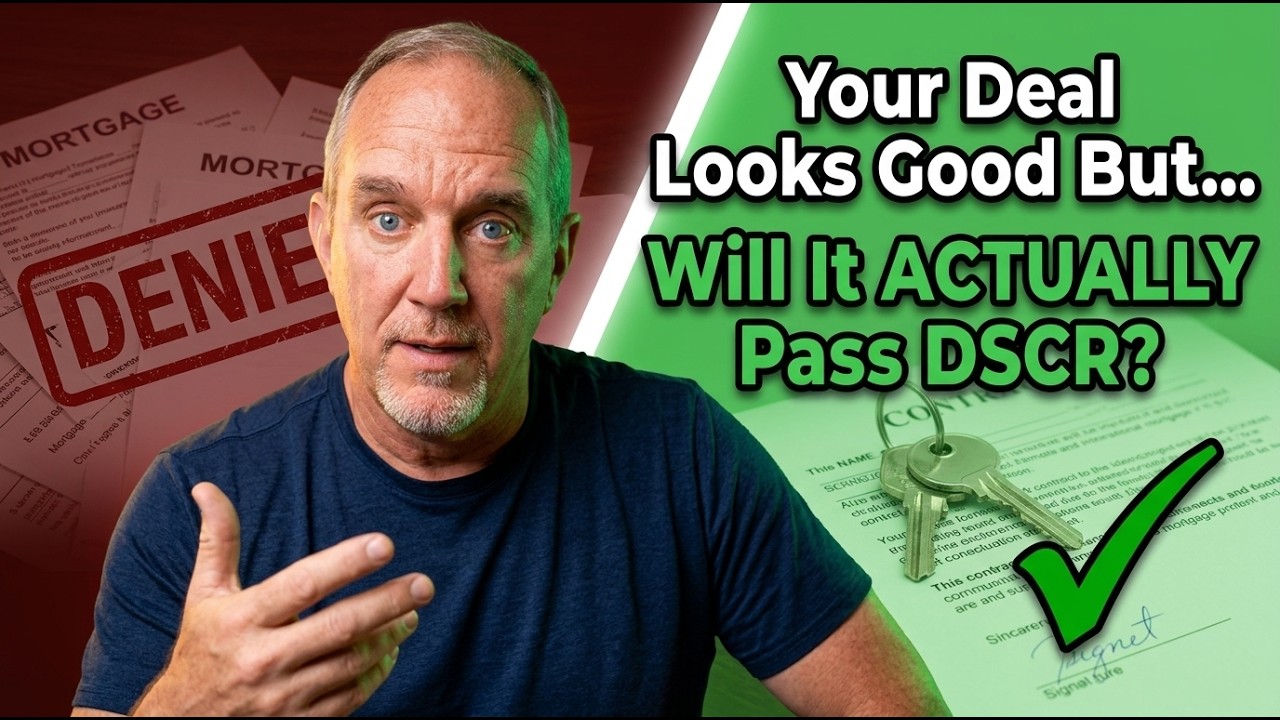
How do I qualify for a DSCR loan in 2026?
To qualify for a DSCR loan in 2026, your property's market rent divided by the full monthly PITIA payment (principal, interest, taxes, insurance, and HOA) usually needs to hit at least 1.0, with 1.25 or higher unlocking the best terms. You also need a credit score generally above 620 to 660 and about six months of PITIA in liquid reserves after closing.
How do I qualify for a DSCR loan in 2026?
To qualify for a DSCR loan in 2026, your property's market rent divided by the full monthly PITIA payment (principal, interest, taxes, insurance, and HOA) usually needs to hit at least 1.0, with 1.25 or higher unlocking the best terms. You also need a credit score generally above 620 to 660 and roughly six months of PITIA in liquid reserves after closing. Miss any one of these benchmarks and a solid deal can still get denied.
About 40% of DSCR applications that reach underwriting get sent back for problems the borrower could have caught before applying. Most of these investors have good deals. The property cash flows, the credit is fine, but they miss one or two specific numbers and end up starting the whole process over. Let's walk through what actually matters so you can check your own deal first.
What is the DSCR ratio and how is it calculated?
DSCR stands for debt service coverage ratio. In plain English it is a fraction. You take the property's monthly rent and divide it by the full monthly mortgage payment. When lenders say full payment, they mean PITIA: principal, interest, taxes, insurance, and any HOA dues. Not just principal and interest.
This is where many investors get tripped up. They punch a loan amount into a calculator, pull the principal and interest figure, compare it to rent, and celebrate a 1.3 ratio. Then the lender adds property taxes, homeowners insurance, and HOA on top. Suddenly that 1.3 is really a 1.05 or worse, a 0.95.
Here is a concrete example. Say you are looking at a single family rental priced around $350,000 with 25% down. Your estimated principal and interest, plus property taxes and insurance, might add up to a total PITIA near $2,160 a month. If the appraiser reports market rent of $2,500, your DSCR is 2,500 divided by 2,160, which equals about 1.16.
You qualify, but you are not in the sweet spot. Most lenders approve at a 1.0, meaning rent just barely covers the payment. The best rates and terms usually kick in at 1.25 or higher. The gap between a 1.0 and a 1.25 ratio can cost you a meaningful amount over the life of the loan in rate adjustments alone.
Does credit score matter on a DSCR loan?
Yes. Even though DSCR loans do not verify your personal income, your credit score is still a major factor. The technical floor at most lenders is around 620 to 660. But just because you can qualify at 620 does not mean you should apply at 620.
The pricing tiers work like a staircase. At 740 and above you unlock the best rates and can often reach up to 80% loan to value, meaning only 20% down. From 700 to 739 you might see a small rate bump. At 680 to 699 the deal still works for most investors but costs a bit more. Below 680, terms tighten fast: higher rate, lower loan to value, and sometimes extra reserve requirements.
If you are sitting near 670, spending 60 to 90 days cleaning up your credit before applying can change the entire economics of the deal. You can pull your report for free at AnnualCreditReport.com and review how scores work at the Consumer Financial Protection Bureau.
How many months of reserves do DSCR lenders require?
Reserves are the liquid cash you have in the bank after closing, after your down payment is already paid. Most DSCR lenders require about six months of your full PITIA payment in liquid reserves.
Put a number on it. If your total monthly payment is around $2,160, six months of reserves means roughly $12,960 in verified liquid funds after your down payment clears. That includes cash savings, money market accounts, and stocks. Some lenders count retirement accounts at about 60 to 70% of vested value. Crypto usually does not count unless it has been liquidated and sitting in a U.S. bank account for a couple of months.
I had an investor last year with a strong cash flow property, 740 credit, and 25% down. After the down payment, he was about $8,000 short on reserves. The money existed, it was just in a brokerage account he had not transferred. He had to pause, move the funds, season them for 30 days, and resubmit. That added five weeks, his rate lock expired, and he relocked higher. All avoidable if he had mapped out reserves first.
Your action step: multiply your estimated total monthly payment by six. That is your reserve target. Then look at your bank balance after subtracting down payment and closing costs. If you are short, start moving funds now, because lenders need to see money seasoned in the account.
Which property types qualify for a DSCR loan?
Not every rental qualifies. Standard eligible properties include single family homes, 2 to 4 unit multifamily (duplex, triplex, and fourplex), condos, and town homes. Short-term rentals also work, with a twist.
Most lenders apply a 20 to 25% haircut to projected short-term rental income. If a data source says a property will generate $5,000 a month, the lender might only credit $4,000 or even $3,750. Run your DSCR using the discounted number, not the optimistic one.
What does not qualify: raw land, properties needing major renovation before they can be rented, and commercial properties like office or retail. The property needs to be rent ready at closing.
Can I close a DSCR loan in an LLC?
Yes. DSCR loans fully support LLC ownership. You will need your articles of organization, operating agreement, and EIN. You can learn how to obtain an EIN directly from the IRS.
Most experienced investors close in an LLC because it keeps the loan off their personal credit report, which protects their personal debt to income ratio for future deals.
Why do DSCR loan applications get denied?
Here are the five most common reasons, and every one is fixable if you know about it ahead of time.
- The investor calculated only principal and interest, not the full PITIA.
- The appraiser reports a market rent lower than expected. Lenders use appraised market rent, not what you charge or what a listing site shows.
- Not enough liquid reserves after the down payment clears.
- The property is a short-term rental but the lender uses long-term rent comps instead of short-term income. Ask upfront how they calculate it.
- The credit score clears the floor but triggers a higher down payment or lower loan to value the investor did not budget for.
Your 3-step DSCR pre-qualification checklist
Step 1: Get a rent estimate. Use a rent comparison tool or call a local property manager. Estimate your full PITIA with a calculator that includes taxes and insurance, then divide rent by PITIA. At or above 1.0 you are in the conversation. At 1.25 or higher you are in the sweet spot.
Step 2: Pull your credit for free at AnnualCreditReport.com. If you are below 680, consider improving your score first. Every 20 point gain can save a meaningful amount on rate.
Step 3: Calculate total cash needed. That is down payment plus closing costs plus six months of PITIA. If that total exceeds your liquid verified funds today, build a plan to bridge the gap before you start the application.
Most lenders give you a rate. Knowing your numbers before you apply is the difference between closing and starting over.
Run your deal before you apply
If you have a property you are looking at and want to know whether it pencils for a DSCR loan before you go further, bring it to a free strategy call. We will run the numbers together and tell you straight whether it works.
Frequently asked questions
What DSCR ratio do I need to qualify for a loan? +
Most lenders will approve a DSCR loan at a ratio of 1.0, meaning market rent just covers the full PITIA payment. However, the best rates, terms, and loan to value options generally start at 1.25 or higher. Anything below 1.0 means the property does not fully cover its own payment, which most lenders will decline or price much higher. Always calculate the ratio using the full payment including taxes, insurance, and HOA, not just principal and interest.
Do DSCR loans check my personal income? +
No. DSCR loans qualify the property based on its rental cash flow rather than your personal income, so there are no W-2s, tax returns, or pay stubs required for income. That is what makes them popular with self-employed investors and those with complex tax returns. Your credit score, liquid reserves, and the property's appraised market rent still matter a great deal, so the loan is not a no-documentation product overall.
How much cash do I need for a DSCR loan? +
Plan for three things: your down payment, closing costs, and reserves. Down payments commonly run around 20 to 25% depending on your credit score and loan to value. On top of that, most lenders require about six months of the full PITIA payment in liquid reserves after closing. Add these together to find your true cash needed. If the total exceeds your verified liquid funds today, you will want to move and season money before applying.
Can short-term rentals qualify for a DSCR loan? +
Yes, but lenders treat them differently. Most apply a 20 to 25% haircut to projected short-term rental income, so if a data source estimates $5,000 a month, the lender may only credit $4,000 or less. Some lenders instead use long-term rent comps, which can lower your DSCR unexpectedly. Ask upfront exactly how a lender calculates short-term rental income, then run your ratio using the discounted number rather than the optimistic projection.
Should I close a DSCR loan in an LLC? +
You can, and many experienced investors do. DSCR loans fully support LLC ownership. You will need your articles of organization, operating agreement, and EIN. Closing in an LLC keeps the loan off your personal credit report, which helps protect your personal debt to income ratio for future purchases. It can also offer liability separation, though you should confirm the specific setup with your attorney and tax professional before you commit.
What credit score is best for a DSCR loan? +
The floor at most lenders is around 620 to 660, but higher is much better. At 740 and above you unlock the best rates and can often reach up to 80% loan to value. From 700 to 739 you may see a small rate bump, and 680 to 699 still works for most investors at slightly higher cost. Below 680, rates rise, loan to value drops, and some lenders require extra reserves, so improving your score first often pays off.
Sources
- Credit Reports and Scores — Consumer Financial Protection Bureau
- AnnualCreditReport.com — AnnualCreditReport.com
- Apply for an Employer Identification Number (EIN) Online — Internal Revenue Service
About the author
Matt Robertshaw — Mortgage Strategist
NMLS #925153
With a passion for strategy and over two decades of experience in the residential mortgage industry, Matt saw a crucial need for a different approach. Our company's foundation lies in the belief that success stems from well-crafted strategies tailored to individual clients. As your trusted Mortgage Strategist, Matt utilizes his expertise and advanced tools to understand your unique financial objectives, both short and long term. By analyzing market trends, interest rates, and personalized factors, he formulates the most advantageous mortgage plans for home buyers and current homeowners alike. The Mortgage Strategists is committed to providing a seamless, personalized customer experience, bridging the gap between dreams and reality. Discover the power of strategy and unlock your path to financial success with The Mortgage Strategists.
Ready to talk numbers?
Schedule a 15-minute call. We'll walk through your situation and show you what's actually possible — no pressure, no pitch.
Book a call

